
Arabic Calligraphy vs Arabic Fonts: Why They Look Similar but Work Differently
Introduction: Is Arabic Calligraphy the Same as an Arabic Font?
Arabic writing can look simple and elegant in one design, then turn into something beautifully detailed in another. You might see flowing Arabic lettering on a wedding invitation, bold calligraphy on a wall, or decorative Arabic text in someone’s Instagram bio. They may look similar at first, but they aren’t necessarily made the same way.
Arabic calligraphy is an art form, while an Arabic font is a digital way of displaying text. Some fonts are designed to imitate traditional calligraphy, which is why the two can look so alike.
Understanding the difference helps you choose the right option for your project, whether you’re designing a logo, creating Islamic wall art, styling a social media post, or simply writing Arabic online.
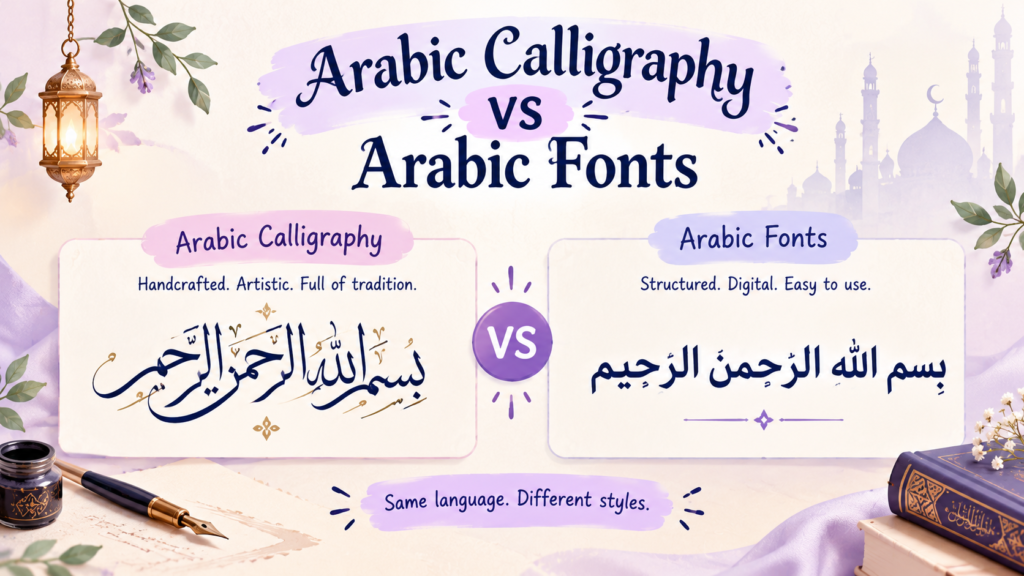
Let’s look at how each one works, where they’re most useful, and what you can actually copy and paste.
What Is Arabic Calligraphy, Really?
The Art Behind Traditional Arabic Lettering
Arabic calligraphy, known as khatt in Arabic, is the art of writing beautifully. It has a long history and an important place in Islamic art and many Arabic-speaking cultures.
Traditional calligraphers use carefully controlled strokes, proportions, spacing, and letter shapes to create a balanced composition. Historically, tools such as the reed pen (qalam) and ink played an important role in this practice.
It’s not simply a matter of making letters look fancy. A skilled calligrapher pays attention to how the letters relate to one another, how the lines flow, and how the entire piece looks together. Traditional Arabic calligraphy is especially prominent in Qur’anic manuscripts, mosque decoration, architecture, and other forms of artistic expression.
Popular Arabic Calligraphy Styles You Often See
Different calligraphy styles have their own personalities. Here are five you may come across:
- Naskh: Clear, rounded, and highly readable. It’s widely associated with printed Arabic text.
- Thuluth: Large, sweeping, and decorative, often used for headings and architectural inscriptions.
- Diwani: Flowing and elaborate, developed in the Ottoman court tradition.
- Kufic: Known for its angular, geometric appearance, with forms that work well in both historical and contemporary designs.
- Ruq’ah: A compact, practical style associated with everyday handwriting.
These styles aren’t interchangeable. A word written in geometric Kufic can look dramatically different from the same word written in flowing Diwani.
Why the Same Words Can Look Completely Different in Calligraphy
Calligraphy is an art; the same word can be written countless ways.
The two calligraphers write the same phrase, but the outcome is something else: two completely different beautiful phrases. One might create a tall, balanced composition, while the other uses long curves and decorative flourishes. The artist can make choices about composition, proportions, and the overall arrangement of the letters to suit the piece.
What Are Arabic Fonts?
How Digital Arabic Fonts Change the Look of Text
An Arabic font is a digital typeface that determines how Arabic text appears on a screen or in a design.
When you type a phrase, the software uses the selected font to display the letters. Unlike calligraphy (unique each time), a font draws the same letters the same way every time.
You don’t need to draw each letter yourself. Choose a font, type your words, and let the software handle the rendering.
Traditional, Modern, and Decorative Arabic Font Styles
Arabic fonts come in a wide range of designs, including:
- Traditional fonts mimic classic calligraphy styles (Naskh, Thuluth-inspired)
- Modern fonts are clean and minimal, for UI, branding, and readability
- Decorative fonts are stylized for display, logos, and artistic use
The right choice depends on what you’re creating.
Why Some Arabic Fonts Look Like Calligraphy
Some digital fonts take inspiration from styles such as Naskh, Thuluth, or Diwani. They reproduce characteristic letter shapes and visual details, giving typed text a calligraphy appearance.
But they’re still fixed typefaces, not hand-drawn art — so they lack the one-of-a-kind variation a real calligrapher creates.
Arabic Calligraphy vs Arabic Fonts: What’s the Real Difference?
Artistic Writing vs Digitally Designed Letters
The easiest way to understand the difference is to look at how each is created.
- Arabic calligraphy: A calligrapher creates an artistic composition using skill, technique, and deliberate choices about the lettering.
- Arabic fonts: A designer creates a digital typeface that software uses to display text.
- Decorative copy-paste Arabic: Standard Arabic text is combined with decorative symbols or other formatting to give it a different appearance.
A calligraphy-inspired font can look beautiful, but it remains a digital typeface. Likewise, adding symbols around Arabic text doesn’t turn it into traditional calligraphy.
How Letter Shapes, Connections, and Strokes Differ
Calligraphy has living strokes — varying thickness, custom connections, and compositions
In traditional calligraphy, the artist controls the strokes and the overall composition. Letter proportions, spacing, overlaps, and flourishes can be adjusted to achieve a particular style.
A font has fixed glyphs — each letter is pre-drawn, and the software connects them automatically using set rules. Calligraphy can overlap, stack, and flow creatively, whereas a font follows consistent spacing.
Which Offers More Control Over the Final Design?
It depends on what you want to achieve.
Calligraphy is a strong choice when you want a custom artistic piece with a particular arrangement or visual character. It takes specialist skill and time.
Fonts are more convenient when you need to edit text, reuse it, or create several versions of a design. You can change the words, size, color, and layout without commissioning new lettering each time.
You can easily remember the difference:
For a unique masterpiece → calligraphy.
For fast, repeatable text → a font.
The Same Arabic Words, Three Different Looks
Let’s use the phrase السلام عليكم (As-salamu alaykum, meaning “peace be upon you”) to see how the presentation can change.
- Traditional Arabic Calligraphy: Hand-drawn, Diwani style: السلام عليكم — flowing, ornate, with custom flourishes and a unique composition. A piece of art.
- Standard Arabic Typography: In a clean font like Naskh: السلام عليكم — consistent, readable, exactly as rendered by the font every time.
- Decorative Arabic Text (Copy-Paste): The same words decorated with symbols and frames: ꧁ السلام عليكم ꧂ — the letters stay standard, but symbols add flair for a bio or post.
Same words, three completely different looks — and three different tools (an artist, a font file, a copy-paste generator).
Why Arabic Text Changes Shape Across Different Fonts
How Connected Arabic Letters Work
Arabic is written from right to left, and many letters connect to neighboring letters within a word. Their appearance can change depending on where they occur.
This is why Arabic text isn’t simply a row of identical, separate characters. The software displaying it needs to determine which letter forms to use and how they should connect.
Initial, Medial, Final, and Isolated Letter Forms
Many Arabic letters have different forms depending on their position:
- Isolated: The letter appears on its own.
- Initial: Start of a word
- Medial: Middle, joined on both sides
- Final: End of a word
Not every Arabic letter connects on both sides, so the available forms depend on the letter.
When you type Arabic, the shaping system selects the appropriate forms based on the text and the font’s capabilities. That’s why the same letter can look different in different words, and why changing fonts can alter the overall appearance of a phrase.
Why Some Letter Combinations Look More Elegant Than Others
Arabic typography also uses ligatures, in which certain letter combinations are displayed as a combined shape. The combination لا (lam-alif) is a familiar example.
Well-designed Arabic fonts handle joining and spacing carefully, helping the text look balanced rather than crowded or disconnected.
Calligraphers can go further by adjusting the composition for a particular phrase. This is one reason custom calligraphy may have a distinctive visual flow that a standard font doesn’t reproduce exactly.
Can an Arabic Font Look Like Real Calligraphy?
Calligraphy-Inspired Fonts vs Traditional Calligraphy
Yes, some Arabic fonts closely imitate the appearance of calligraphy. Fonts inspired by Diwani or Thuluth, for example, can give a design a traditional, decorative feel.
For a poster, invitation, social media graphic, or website heading, this may be exactly what you need. You can type your phrase, adjust its size and color, and place it in your layout.
What Digital Fonts Can Recreate & What They Cannot
A calligraphy-inspired font can reproduce characteristic letter shapes, stroke styles, and much of the visual feel of a particular tradition.
A font may also include ligatures and alternative forms that offer more variety than basic text rendering.
Remember, a font doesn’t automatically provide a custom composition created specifically for your phrase. A calligrapher can adjust the lettering and arrangement to suit the meaning, space, and purpose of the artwork.
Neither option is better. They serve different needs.
When a Decorative Font Is Enough
You don’t always need custom calligraphy to create something beautiful.
A suitable Arabic font can work well for social media graphics, invitations, posters, website headings, and many everyday design projects. It’s especially useful when you need to make edits or reuse the text in different places.
For a bespoke artwork, a carefully composed logo, or a piece where the lettering itself is the main attraction, custom calligraphy may be a better fit.
Arabic Calligraphy vs Arabic Fonts: Which Is Easier to Read?
Everyday Arabic Text vs Decorative Lettering
If you want readability, a clear Arabic font is usually the safest starting point. Naskh-style fonts are widely used for readable Arabic text, while highly ornate lettering can take longer to decipher.
That doesn’t mean decorative calligraphy is unreadable. Its legibility depends on the style, the words, the size, and the reader’s familiarity with the lettering.
Readability on Phones and Small Screens
A design that looks beautiful may become difficult to read on a phone.
Thin strokes, intricate flourishes, and tightly arranged letters can lose clarity at smaller sizes. If you’re designing a mobile graphic or social media post, check how it looks on an actual phone rather than judging it only on a large screen.
For profile text and short captions, keep the wording simple and avoid unnecessary decoration.
Choosing a Style for Long Text or Short Phrases
A useful rule of thumb is to match the style to the amount of text.
- Long articles and documents: Choose a readable Arabic font designed for continuous text.
- Headings and short quotes: Decorative fonts may work well if the wording remains clear.
- Logos and artwork: Consider custom calligraphy when the lettering needs to be part of the design itself.
The goal is to find a balance between appearance and readability, rather than sacrificing one completely for the other.
Where Should You Use Arabic Calligraphy and Arabic Fonts?
The best choice depends on where the lettering will appear and what you want it to communicate.
| Where you’re using it | A suitable option | Why it works |
|---|---|---|
| Islamic art and wall décor | Traditional calligraphy or a carefully chosen calligraphic font | Creates a distinctive artistic presentation |
| Logos and brand identities | Custom calligraphy or a suitable Arabic typeface | Can give the design a recognizable character |
| Wedding invitations | Decorative Arabic fonts or custom calligraphy | Works well for names, short phrases, and headings |
| Instagram bios and captions | Standard Arabic text with decorative symbols, where supported | Easy to copy and paste |
| Websites and documents | A clear, well-supported Arabic font | Helps readers follow longer text |
| Posters and social media graphics | A decorative or modern Arabic font | Lets you balance visual style with readability |
For logos and commercial designs, remember to check the font’s license if you’re downloading a typeface. For religious or culturally significant text, also take care to preserve the wording and meaning.
Can You Copy and Paste Arabic Calligraphy Online?
How Decorative Arabic Text Generators Work
Here’s an important distinction: a picture of Arabic calligraphy and copy-paste Arabic text are not the same thing.
Traditional calligraphy is often shared as an image or artwork. You can copy the image into a design or save it as a picture, but it doesn’t behave like ordinary editable text.
Online text generators, on the other hand, can help you decorate standard Arabic writing with symbols and frames. For example:
<escape>꧁ السلام عليكم ꧂</escape>
You can try our Urdu & Arabic Stylish Text Generator to create decorated Arabic text for supported social media fields and messages.
Unicode Text vs Images of Calligraphy
The difference becomes clearer when you try to use each one.
- An image of calligraphy: Preserves the artwork’s visual appearance as an image, but the lettering isn’t ordinary editable text.
- Copy-paste Arabic text: Contains text characters that can be copied, edited, and placed in compatible fields.
- A downloadable Arabic font: Changes how text is rendered in software that supports the font. The recipient may need access to the same font to see the intended appearance in some files or applications.
Honest key point: unlike English, there are no “fancy,” “bold,” or “calligraphy” Arabic letters in Unicode. The styled Latin sets (𝐛𝐨𝐥𝐝, 𝓬𝓾𝓻𝓼𝓲𝓿𝓮) don’t exist for Arabic. So copy-paste “fancy Arabic” is really decorated Arabic (symbols around normal letters), not restyled letters.
Why Copied Arabic Text May Look Different on Another Device
Have you ever copied Arabic text that looked one way on your phone and slightly different on a computer?
This can happen because devices and applications may use different Arabic fonts and text-rendering systems. The same text can therefore appear with different letter shapes, spacing, or proportions.
If you’re interested in why this happens, read our guide to why Arabic text looks different on different devices.
Why Some Fancy Arabic Text May Not Work in Every App
Decorative symbols aren’t supported consistently everywhere. Some apps may remove certain characters, while older devices or unsupported fonts may display boxes instead.
If your text looks broken after pasting it, try removing the decorative symbols and testing the standard Arabic phrase first. If that works, add the decoration back gradually until you find a version that displays properly.
For important messages, readability is more valuable than using every available symbol.
How to Choose the Right Arabic Style for Your Needs
Still unsure which option to use? Think about what you’re making.
- Choose traditional calligraphy when you need a unique art piece — Islamic wall art, a custom logo, or a carefully composed design.
- Choose a downloadable Arabic font when you’re designing — a poster, invitation, or branding where you need consistent, print-quality typography with control.
- Choose copy-paste decorative Arabic when you want styled Arabic in a bio, caption, username, or message — no install, works instantly online.
- Choose a clean Arabic font when people need to read longer text comfortably, especially on smaller screens.
You can also combine approaches. For example, a poster might use custom calligraphy for its main phrase and a readable digital font for the supporting information.
Is Arabic calligraphy a font?
No. The calligraphy is hand-created art, whereas a font is a digital typeface. Some fonts imitate calligraphy, but true calligraphy is unique handwriting, not a repeatable font.
Which font is best for Arabic writing?
It depends on the purpose. A readable Naskh-style font is a good starting point for longer text. Decorative fonts inspired by calligraphy may suit headings, invitations, and artwork. Always check the font’s Arabic support and readability before using it.
What are the rules of Arabic calligraphy?
Traditional Arabic calligraphy follows the conventions of its particular style. These can include letter proportions, pen angles, stroke shapes, spacing, and composition. Different calligraphic traditions have their own rules, which take practice to master.
What are the two main styles of Arabic calligraphy?
Broadly, there are two main foundational families: Kufic and Naskh. These are two important historical styles, but Arabic calligraphy includes many others, such as Thuluth, Diwani, and Ruq’ah.
What is the difference between Arabic typography and calligraphy?
Typography is digital font design (consistent, repeatable); calligraphy is hand-created art (unique each time). Typography is for everyday/digital text; calligraphy is for artistic pieces.
Which Arabic calligraphy style is easiest to read?
Naskh — it’s clear, rounded, and designed for readability, which is why it’s the basis of most printed and digital Arabic.
Can I use Arabic calligraphy in my Instagram bio?
You can’t paste a complete image of calligraphy into a text field. However, you can paste standard Arabic text and, where supported, decorate it with symbols. For a graphic containing actual calligraphy, you would generally use an image instead. See our Urdu & Arabic text tool.
Are Arabic calligraphy fonts free to use commercially?
Some are free for commercial use, while others have restrictions. Always check the specific font’s license before using it in a logo, product, advertisement, or other commercial project. Don’t assume a font is free for every use just because you can download it.
Why does Arabic text look different on different devices?
Devices and applications may use different fonts and rendering systems. These differences can affect letter shapes, spacing, and the overall appearance of the same Arabic text. Unsupported characters may also display incorrectly.
Final Thoughts: Choose the Arabic Style That Fits Your Project
Arabic calligraphy and Arabic fonts both produce beautiful writing, but they’re different tools for different jobs.
Calligraphy is hand-created art — unique, masterful, perfect for a one-of-a-kind piece.
Fonts are digital typefaces — consistent and convenient, ideal for design and everyday text.
And for social media, Copy-paste Arabic text offers another option when you want to add decoration to a bio or message quickly.
If you’re creating artwork, consider calligraphy. If you’re designing a poster or writing a document, start with a suitable font. And if you simply want to decorate Arabic text for social media, a copy-paste tool may be all you need.
You can experiment with the options using our Urdu & Arabic Stylish Text Generator and choose the style that works best for your needs.